
Business management is similar. It's time we talked about a unified digital transformation platform – where every process, from human resources and finance to production and business, is contained within a single "ecosystem."
Common business problems
Foundation
Digital transformation
60%
Save time on manual labor
50%
Increase work efficiency
1tr+
Trusted by Vietnamese people.
4 Steps to Get Started
Process evaluation and standardization
&c2=rgba(0,0,0,.5)&c4=o-color-4&c5=o-color-5)
Design data flow that suits the specific needs.
&c4=o-color-4&c5=o-color-5)
Phased implementation
&c2=rgba(0,0,0,.5)&c4=o-color-4&c5=o-color-5)
Training and adaptation
Solving business operational problems with digital transformation systems.
Integrate applications within the same system.
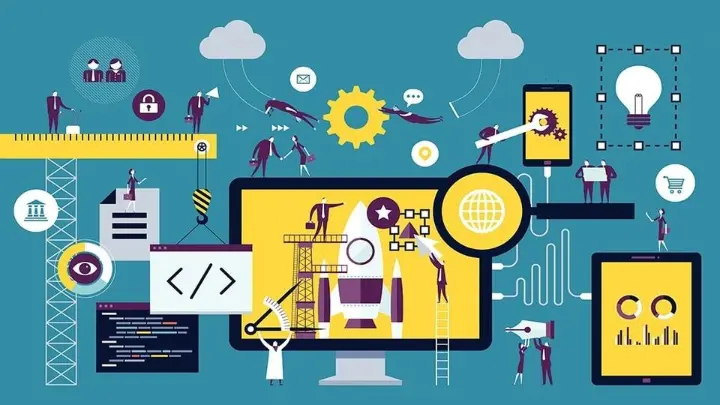
5 Pillars of Strength When Operating on a Single Platform
Process automation
Imagine this: When an order is confirmed on the website, the system automatically deducts inventory, creates a production order, notifies the shipping company, and updates revenue in the financial reports. No human intervention is required.
Centralized data - The only truth
Every employee, from warehouse workers to the CFO, looks at the same number. This completely eliminates any debate about the accuracy of the data.
Optimizing the customer experience
You know who that customer is, what they've bought, what their previous complaints were... the moment they pick up the phone to call. That's the power of integrated data.
Financial management down to the last penny.
Automated accounting capabilities allow businesses to immediately track profit margins on each product and project, instead of waiting until the end of the month.
Collaborative work culture
Eliminate barriers between departments. All communications and documents are stored on the platform, facilitating seamless collaboration.

Ultimately, a platform doesn't replace human judgment. It sharpens it. It doesn't eliminate individual responsibility, but exposes it. And it is in this way that a platform not only supports a business, but becomes the backbone that allows it to stand tall and see far ahead.