
Skip to Content

DIGITAL TRANSFORMATION HANDBOOK FOR BUSINESSES: UNDERSTAND CORRECTLY – DO CORRECTLY – OPTIMIZE

December 10, 2025 by
DIGITAL TRANSFORMATION HANDBOOK FOR BUSINESSES: UNDERSTAND CORRECTLY – DO CORRECTLY – OPTIMIZE
Nguyễn Văn Minh

​This article acts as a “handbook” to help businesses fully understand the nature of digital transformation, identify the right time to change, and grasp the roadmap – formula – success factors.

1. What is digital transformation?

1.1 Concept
​The concept of “Digital Transformation” (DT) does not have a single internationally agreed definition, but there are some common interpretations that help clarify its nature and content.
According to the definition from consulting organizations: digital transformation is “using digital technologies to change business models, creating new opportunities, revenue and value”.
​Another broader understanding: it is the process of integrating digital technologies into all aspects of organizational/business operations — from processes, structures, cultures, ways of working — to fundamentally change the way services or products are operated and provided.

​Thus, “digital transformation” includes both technological factors (digital technologies) and organizational-human factors (processes, models, culture). In this context, simply “digitizing” data or processes (digitization / digitalization) is not enough: the key is to use technology to completely restructure — that is, “transformation”.

1.2. Digital transformation and differentiation
  • Distinguishing between “Digitization” and “Digital Transformation”

In the theory of digital transformation, it is very important to distinguish between “digitization” (digitization / digitalization) and “digital transformation”

Terminology

T

Meaning / Scopedep

Limit


Digitization

Just improve the “form” part — data, storage, operations — without deeply changing the organizational model, operations, or value creation.


Digital transformation

A more in-depth process: using digital technology + restructuring processes, business models, culture, and people to create new value, improve performance, enhance competitiveness and innovation.

Requires long-term commitment, a change in mindset, and a clear strategy — not “gluing technology on” but “complete restructuring.”

Convert information/data from analog/paper format to digital format, or transform manual processes into technology-based processes — for example, from paper to soft files, from manual to software-enabled processes.

  • Three Most Common Misconceptions
Misconcept 1: Digital transformation = technology adoption
This is the biggest mistake.
Technology is just a tool, while digital transformation is about changing the way businesses operate.
A “good enough” software with the right management philosophy is more effective than many expensive systems with the wrong direction.
​Misconcept 2: Digital transformation is expensive and only for large enterprises
Although IDC estimates the global cost of digital transformation at up to $2 trillion, 88% of CIOs of large enterprises still admit to having failed.
So, money is not the deciding factor.
Small businesses can absolutely start with flexible, platform solutions.
​Misconcept 3: Digital transformation is a playground for technology startups
Many people look at Uber, Airbnb, Spotify and think that digital transformation is only for “giants”.

Fact: Traditional businesses are the mainstay of the economy, and can absolutely transform if they follow the right path with an open mind.

1.3. The role and significance of digital transformation
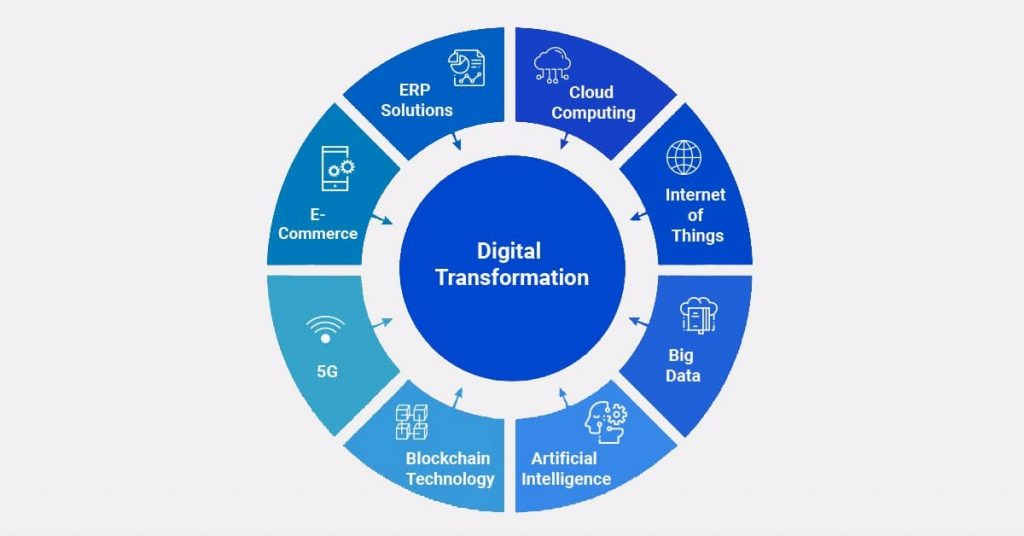
​Digital transformation brings many clear benefits to businesses and organizations — both in terms of operational efficiency, competitiveness, customer experience, and the ability to innovate and sustain. Some highlights:
Optimizing operations, saving costs: Thanks to process automation, management systems, and cloud computing storage, businesses can minimize errors, save time, resources, and operating costs.
​Managing and using data effectively — making data-driven decisions: Digital transformation helps businesses collect and analyze customer data, business processes, and operational efficiency, thereby making faster, more accurate, and more strategic decisions.
​Increasing competitiveness and innovating business models: When businesses restructure their models, customer approaches, and value creation methods, they can create new products, services, and new experiences to better meet market needs.

​Adapting to the global context — An inevitable trend in the digital age: With the rapid development of technology, markets, and customer behavior, digital transformation is no longer an option but is gradually becoming a mandatory requirement for businesses to survive and develop.

2. Why do businesses need to transform digitally?

2.1. Short-term goals: Solve core “operational pain points”
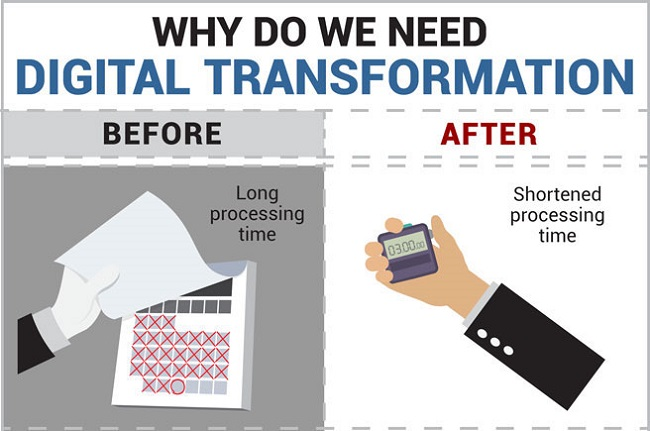
​In the short term, the strongest driving force for businesses to transform digitally comes from internal problems that have existed throughout the operation process. Most businesses, especially small and medium-sized businesses, face cumbersome processes, lack of flexibility, and rely too much on manual operations. This makes it impossible for organizations to respond quickly to changes, and even lose the ability to expand when market demand suddenly increases. At the same time, the dispersion of resources – from human resources, information, to systems – leads to significant waste that businesses cannot easily recognize without a strong enough measurement tool or data system.
​Another important reason is the lack of consistency in governance. When departments operate in a fragmented manner, using different tools and processes, businesses fall into a state of “each in a different way”, causing information to be delayed, incorrect or lost. This makes it difficult for leaders to make timely decisions, and for functional departments to synchronize actions. More seriously, many businesses lack data for analysis, forecasting or strategic planning. When data is low, fragmented and manual, it is difficult for organizations to break through.
​Deploying digital transformation helps businesses quickly solve these problems. When processes are digitized and automated, businesses become leaner, saving significant time and operating costs. Integrated management systems help information to be synchronized, transparent and accurate, enabling leaders to make quick decisions, based on evidence rather than emotions. Improved data capabilities allow organizations to forecast better, plan more effectively and be more proactive in business operations. Thus, in the short term, digital transformation creates real value – from accelerating growth to cutting costs and improving decision-making efficiency.
2.2. Medium-term goal: Overcoming the VUCA context
​In the current socio-economic context, every organization operates in a VUCA environment, which is characterized by volatility, uncertainty, complexity and ambiguity. This is a term widely used in management science to describe the reality of the global market, where technology changes rapidly, customer behavior fluctuates constantly and competition is increasingly fierce. In this context, traditional operating models – which depend heavily on stability and predictability – are no longer suitable.
​Digital transformation becomes a tool to help businesses develop three vital medium-term capabilities. First, agility is greatly improved when businesses can quickly change processes, structures or business models thanks to technology platforms. Second, businesses become leaner when manual, redundant tasks are eliminated, and automated systems replace error-prone steps. Third, businesses develop smart decision-making capabilities based on data instead of intuition. When analytics and forecasting systems are put into operation, businesses can better understand the market, identify risks earlier and seize opportunities more effectively.
​Thanks to these three capabilities, businesses not only "survive" in the VUCA environment but also have the ability to turn risks into competitive advantages. Digital transformation is therefore not only a technological solution, but also a factor that creates a strategic foundation for organizations to adapt and develop sustainably.
2.3. Long-term goal: Stay competitive and avoid being left behind

​In the long term, digital transformation is no longer an option but a requirement. The reason lies in the speed of technological change and the shift of the global market. International research shows that within the next decade, nearly 40% of Fortune 500 businesses may disappear or be replaced by businesses that can adapt faster. This number emphasizes an undeniable truth: businesses that stand still are businesses that are falling behind.
​The development of AI, automation, e-commerce, data analytics technology and platform-based business models has made customers expect more in terms of speed, quality and experience. Competitors of businesses – not only in the same industry but also from completely different industries – are using technology to expand operations, optimize costs, improve customer experience and penetrate markets quickly. If businesses do not change, do not rely on data to make decisions and do not digitize processes to improve efficiency, they will gradually lose market share and competitiveness.

​Digital transformation in the long term therefore plays a role as a sustainable development strategy. It not only helps businesses modernize their operating models, but also creates a foundation for continuous innovation. When data, technology and processes are integrated,  Businesses can expand into new business models, increase service quality, improve productivity and enhance customer experience. These are the decisive factors that help businesses maintain their position, survive and grow in the next decade.

3. Signs that businesses need to transform digitally immediately

​Sign 1: The old way of doing things no longer produces the old results
Like Nokia – not wrong, just “not keeping up with the times”.
When the market changes rapidly, businesses that try to cling to old successes will fail.

​Sign 2: Leaders lose control – standards are lowered
Businesses grow, processes expand, errors increase.
At this time, digital tools help ensure operating standards and consistency.

​Sign 3: Managers cannot make decisions due to lack of data
Still listening to reports in Excel, chatting on Zalo, paperwork → incorrect, slow, missing data.
Decisions must be based on instant, accurate data, not emotions.

​Sign 4: Employees are overloaded with repetitive manual work


✽  Digital Transformation Roadmap for Businesses: 3 Phases
1

Digitalization – Turning “paper” into “data”

This is a mandatory first step. All paper documents, all manual processes need to be digitized to create “input materials” for the following stages.
For example: invoices, contracts, personnel records, purchase documents, customer information.

When data is on a digital platform, businesses immediately reduce search time, reduce errors and avoid dependence on individuals.

2

Optimize – Do it faster, more accurately

At this stage, businesses start using data to improve old processes.
Time-consuming tasks will be automated.
Redundant, missing or overlapping steps will be eliminated.
Results:
– More efficient operations
– Less overloaded staff
– Leaders have accurate reports, make faster decisions

This is the stage that creates real value to help businesses reduce costs and increase productivity.

3

Transformation – Redesigning the entire operating model

This is the “destination” of digital transformation.
Businesses not only optimize processes, but also rethink operations, even business models.
For example:
– A manufacturing company switches to operating according to the Smart Factory model.
– A distribution company switches to an omni-channel sales model.
– A service unit deploys a digital ecosystem to expand the market.

This is when businesses truly transform.

Here are six factors that determine success.

Most failures in digital transformation do not come from technology, but from a lack of balance between the pillars.

Pillar 1: Digital Customer Experience – Enhancing Every Touchpoint

Modern customers expect fast – simple – personalized experiences.
Technology must be present at every touchpoint: consulting, sales, care, after-sales support.


Pillar 2: Digital Strategy – The compass of the entire journey

Without a strategy, businesses can easily “burn money without getting anything in return”.
A digital strategy needs to clarify:
– What goals does the business want to achieve
– A roadmap for each stage
– Plans for each department
A good strategy helps all resources go in the right direction and avoids wasted investments

Pillar 3: Infrastructure & Digital Technology – Platform for Acceleration

Includes:
– AI & Big Data
– Cloud
– IoT
– Open Platform Ecosystem
Most importantly: technology must be able to integrate.

If the systems are not connected to each other, the business will “break down” in the operational stage.

Pillar 4: Digital Operations – The Backbone of Digital Transformation

Enterprises need to optimize 3 groups of processes:
– Operational processes
– Management processes
– Support processes
Without digital operations, efforts in other departments become ineffective.

This is where businesses “recover capital” the fastest when implementing digital transformation

Pillar 5: Digital Culture – The Soil for Innovation

70% of digital transformation failures are due to culture, not technology.
Digital culture includes:
– Technology mindset
– Data-driven decision making
– Continuous improvement spirit
– Customer centricity
– Collaboration – creativity – fast action

Without digital culture, all changes only exist on paper.

Pillar 6: Digital Data – The “New Oil” of Business

Big Data is considered an invaluable asset of the new-age business.
According to Oracle, data analysis can generate profits 10 times higher than the investment cost.
Small businesses do not need to start big; just focus on:
– Revenue
– Costs
– Operational data

No data → no ability to make the right decisions → no long-term competitiveness.


4. Conclude

​We are entering the digital age – a globalized, hyper-connected and constantly changing world, where new technologies emerge every day and business models are constantly being replaced. In that context, digital transformation is no longer an option to “follow the trend”, but has become a mandatory condition if businesses want to survive, develop and maintain a competitive advantage. Only organizations that dare to leave their comfort zone, dare to reinvent themselves and apply advanced technology can stand firm in the modern race.
​Digital transformation is a long journey, requiring changes at the national, enterprise and individual levels. For the public sector, this process opens up opportunities to improve service quality, optimize the work efficiency of staff, reduce procedural congestion and bring better experiences to citizens. For businesses, digital transformation helps reduce operating costs, increase work processing speed and expand unlimited connectivity – even when traditional resources are limited.
​However, the biggest challenge lies in people. Many businesses still have to retrain their staff to adapt to new technology, thereby prolonging implementation time and incurring additional costs. Therefore, investing in upgrading digital systems, standardizing technology infrastructure and improving human resources capacity is an urgent requirement. Only when the digital ecosystem is completed, will digital transformation be truly sustainable and meet the changing speed of the times.


Share this post
Archive
Decoded Difference: From Manufacturing Chaos to Perfect Automated Line