
In the context of the digital economy, Human Resources (HR) is no longer an administrative department but has become a strategic center that creates competitive advantage. If your business is struggling with manual paperwork processes, scattered data, and high turnover rates, then that is a signal that it is time to implement a strong Digital Transformation (DTS).
With an HRM solution based on digital transformation, it helps businesses transform: from a management burden to a streamlined, efficient human resource system that focuses on employee experience.
⭐ Why should you choose the HRM Digital Transformation system?

HRM Digital TransformationHR Digital Transformation not only improves processes but also creates measurable benefits, helping businesses optimize costs and significantly increase productivity:
- Reduce 60–80% of the time to process human resource procedures such as leave, work confirmation, and contract re-issuance.
- Reduce payroll errors by 40%, thanks to automated calculations and the elimination of manual data entry.
- Cut printing and paper storage costs by 70%, because all documents are digitized.
- Reduce hiring time from 25–30 days to 15–18 days, thanks to automated pipelines and resume screening.
- Increase employee satisfaction (eNPS) from an average of 40–50 to 65–80, thanks to a transparent Self-Service portal.
- Reduce turnover by 20–35%, especially in the first year — thanks to standardized onboarding and clear performance reviews.
1. Subjects
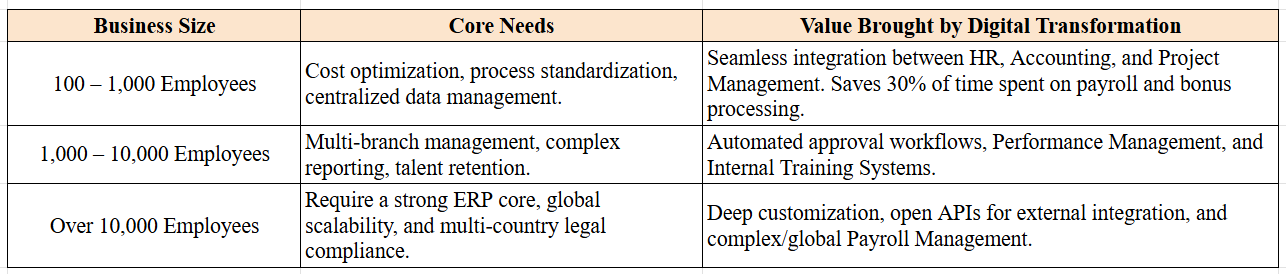
Digital transformation HRM solution, optimally designed for 3 levels of business scale, ensuring flexibility and scalability:
2. Digital transformation process
- Phase 1: Standardization and Digitalization of Data (The Foundation)
🎯 Goal: Establish a data platform and HR system structure so that the entire HR process is unified.
🔹 Digital HR Records
In the data standardization and digitalization phase, businesses need to collect all existing HR records in paper form such as labor contracts, salary increase decisions, personal information, insurance records, contract appendices and other related documents. From the collected data, the next step is to standardize them into clear information groups, including personal information, job information, salary and insurance information, as well as the experience and skills of each employee. After the data is standardized, the enterprise will enter or import directly into the system through pre-prepared Excel template files, ensuring that the data field mapping matches the system structure.
At the same time, a centralized human resource document warehouse will be built in the Documents module, where all types of records such as contracts, performance evaluations, work permits, foreign employee records and other important documents are stored. All documents are managed according to strict authorization by groups such as HR Officer, HR Manager or Payroll Manager, to ensure confidentiality and only authorized people can access. The result of this entire process is to create a "single source of truth" for all human resource activities, helping to reduce errors, eliminate duplicate data and improve search and management capabilities.
🔹 Deploy Core HR Modules
In the step of deploying core HR modules, the enterprise configures all important subsystems to serve the daily human resource process. First, the Recruitment module is set up with job positions, interview process by stage (pipeline), interview invitation email template and a mechanism to directly link to the company's recruitment website to automatically receive candidate profiles. Next, the Contracts module is standardized according to each type of contract such as probationary, official or seasonal, and at the same time allows full tracking of contract appendices by centralized storage. The system also supports tracking effective dates and automatically reminds when the contract is due for renewal.
Along with that, the Time Off module is fully configured with types of leave such as annual leave, sick leave, marriage leave, etc.; The human resources department will assign leave quotas (allocation) to each employee and set up an approval process that is consistent with the organizational structure of the enterprise. When these core modules are deployed synchronously, the entire process from recruitment, contract signing to leave management is standardized according to a unified standard, helping to operate coherently, transparently and minimize errors in manual processing.
🔹 Payroll Setup
In the payroll setup step, the enterprise standardizes the entire income structure of employees, including basic salary, bonuses, allowances and all deductions. The system is fully configured with formulas for calculating social insurance, health insurance and unemployment insurance regimes in accordance with Vietnamese law, ensuring automatic and consistent calculations. The HR department then sets up a periodic payslip template — either monthly or quarterly — and enters old salary data into the system in case the business wants to keep a complete history.
The result of this whole process is a system can automatically calculate accurate salaries, minimize manual errors and ensure transparency in calculating employee income.
- Phase 2: Process automation
🎯 Goal: Minimize manual work, eliminate dependence on Excel, email and paperwork.
🔹 Workflow automation
In this phase, businesses build and set up automatic approval flows for each specific transaction such as leave, overtime or expense payment. The system is also configured with Automation to send emails according to conditions, automatically create tasks (Task) or remind work through Schedule Activity.
Businesses can set up advanced approval conditions, such as requiring overtime over 4 hours to be approved by the director, or expenses over 5 million VND must be transferred to a higher approval level. Thanks to that, the entire system operates completely according to internal regulations without HR having to remind or monitor manually.
🔹 Employee Self-Service Portal
The employee portal allows each employee to manage and look up their own information. Here, they can view their personal profile, download their employment contract, view their monthly payroll, apply for leave, request overtime or update important information such as address and bank account number. Employees can also immediately see the number of remaining leave days without having to contact HR.
The implementation of Self-Service Portal helps HR reduce 60% to 80% of repetitive workload, especially frequent questions like "How many leave days do I have left?", which take a lot of time when processed manually.
🔹 Attendance / Timesheet
Management Enterprises can integrate attendance data from multiple sources, such as biometric timekeeping machines (Ronald Jack, ZKTeco), mobile applications with GPS, or automatically clock in when employees connect to the company WiFi network. Overtime can also be automatically recorded based on registered shifts. All attendance data will be automatically loaded into the system and directly linked to Payroll for salary calculation, ensuring seamlessness and accuracy.
- Phase 3: Optimize experience & strategy
🎯 Goal: Transform HR from an administrative role to a data-driven strategic department.
🔹 Performance / Appraisal
A comprehensive performance appraisal system is built with a set of KPIs specific to each position and OKRs by quarter or year. Enterprises can implement many forms of assessment such as self-assessment, assessment from direct managers or 360-degree assessment from colleagues.
The system allows creating automatic assessment checklists, helping to send reminder emails when it is time for a review. Assessment results are directly linked to salary decisions or promotion recommendations, ensuring transparency and fairness for all employees.
🔹 Internal training (Learning / E-learning)
Enterprises set up a catalog of internal courses, including videos, PDF documents and assessment quizzes. With the e-learning function, training paths can be created for each position, such as the Onboarding path for new employees. After completing the course, the system automatically issues certificates and records progress to serve competency assessment.
For example: New employees joining the company will be automatically assigned an Onboarding course consisting of 5 lessons and a final exam.
🔹 Smart Report & Dashboard (BI)
Digital transformation through the system supports the construction of important dashboards such as turnover rate (Turnover Rate), recruitment time (Time-to-hire), total labor cost (Total Labor Cost), human resource structure by working status, or overtime costs by department. Businesses can use Spreadsheet, Pivot and real-time KPIs for in-depth analysis.
The system also allows setting up warnings such as turnover rate exceeding threshold, abnormally long recruitment process or sudden overtime. Thanks to that, leaders can make decisions based on data quickly and accurately, instead of relying on emotions.
⭐HRM Digital Transformation
HR Digital Transformation is not just a trend, but a foundation for businesses to build a modern, transparent and sustainable human resource system. When data is standardized, processes are automated, and leaders can make decisions based on real-time data, HR will transform from an administrative role to a strategic center of value creation.

Digital HR TransformationThe HR digital transformation roadmap should start with the foundational steps — digitizing data and standardizing processes — then move toward automation and developing long-term strategies such as performance evaluation, training, and HR data analysis. Every small step contributes to a coherent operating system, cost savings, and an improved employee experience.
Businesses can start today by assessing their current HR situation, identifying process bottlenecks, and choosing the right solution for their scale. A modern HRM system not only helps businesses operate better, but also creates a foundation for image for future breakthrough growth. Translate this article into English for me, please translate naturally and accurately, close to my Vietnamese text